
At a glance
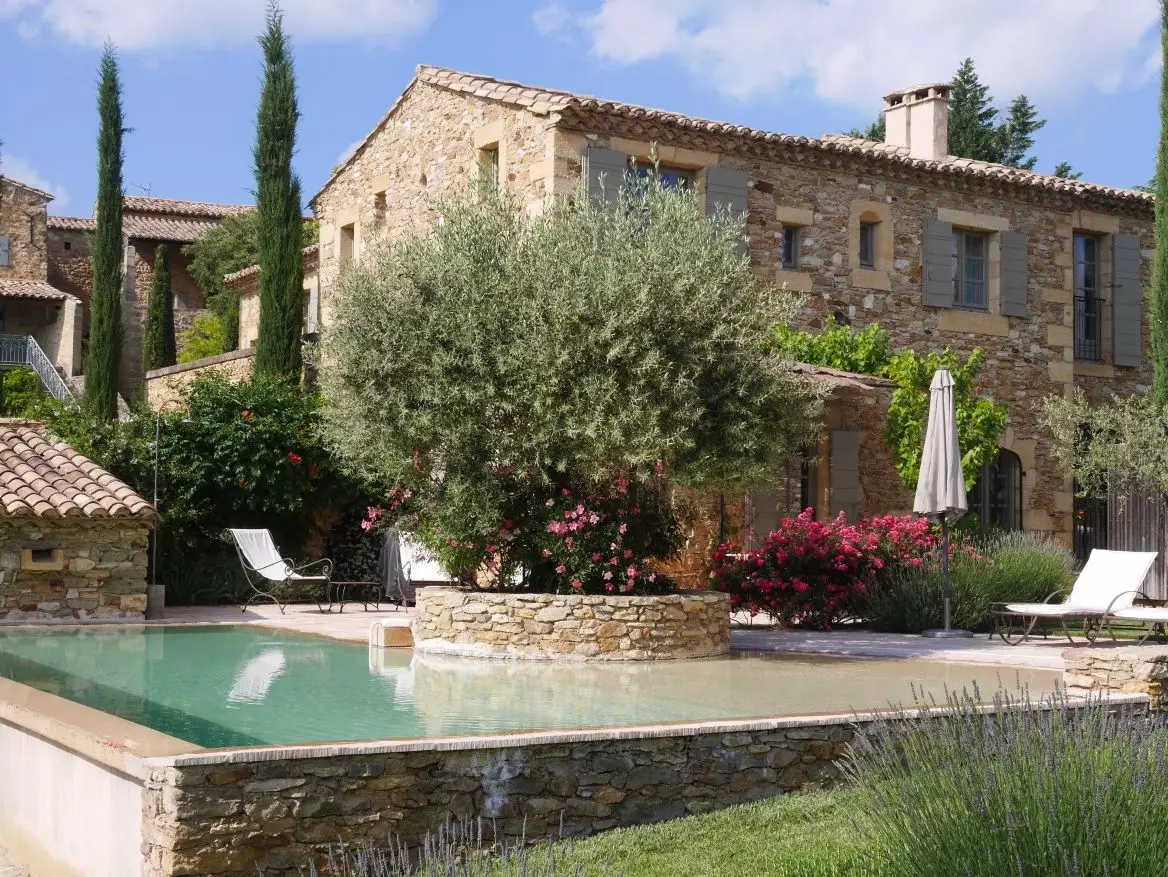
- The mas is a farmhouse that grew longer with each generation: a south-facing front, an almost windowless north wall and a génoise beneath the eaves.
- The bastide is a 17th or 18th-century country residence: a single volume, a symmetrical façade, a four-sided roof and often an avenue of plane trees.
- The farmhouse (ferme) is a working estate arranged around a courtyard, with barns, outbuildings and plain façades.
What is a Provençal mas?
A mas is first and foremost a working house. Built for a farming family, it grew over the generations: a room here, a store there, a sheepfold, so that its roofs step down at different heights. The main façade faces south; to the north, the wall is left almost blind to stand up to the mistral.
Look up at the eaves: the génoise, two or three rows of curved Roman tiles set in lime mortar, is its signature. It is often said that the number of rows reflected the family’s standing.
What is a bastide?
The bastide belongs to another world. In the 17th and 18th centuries, well-to-do families from Aix or Avignon had them built as summer residences and to oversee their land. A single square or rectangular volume; an ordered façade with aligned windows, often over two floors, beneath a four-sided roof.
You can sense one from afar: an avenue of plane trees, a gateway, sometimes a fountain or a pool in the grounds.
What is a Provençal farmhouse?
The farmhouse is the most modest of the three, and often the most adaptable. Arranged around a courtyard, it brings together the living quarters, barn, stables and shed. Plain façades, exposed stone, generous volumes: once restored, it offers what buyers increasingly look for — space, outbuildings and the freedom to reshape the place.
And the village house?
In the hilltop villages, houses rise rather than spread: one room per floor, thick walls, a terrace on the rooftops. In Lagnes, cobbled lanes climb towards the château; behind every door you find the same stone and lime as in the farmhouses of the plain.
Mas, bastide or farmhouse: the differences
| Feature | Mas | Bastide | Farmhouse |
|---|---|---|---|
| Origin | Farming family home | Country residence, 17th–18th century | Working farm |
| Plan | Volumes added lengthways | Single square or rectangular volume | Buildings around a courtyard |
| Façade | Open to the south, north almost blind | Symmetrical, aligned windows | Plain, exposed stone |
| Roof | Stepped pitches, génoise | Four-sided | Varies from building to building |
| Tell-tale sign | The génoise | The avenue of plane trees | Barns and outbuildings |
Why the type of building matters in a valuation
A bastide with its proportions intact, a mas with its original génoise, a farmhouse with its outbuildings: each appeals to different buyers. Before talking about price, we come to see the house, its history and its materials, and then give you an honest view of its value.
Frequently asked questions
What is the difference between a mas and a bastide?
A mas is a farmhouse extended over time, with irregular volumes. A bastide is a country residence designed as a single whole, with a symmetrical façade and a four-sided roof.
What does the number of rows in a génoise mean?
A génoise usually has two or three rows of curved Roman tiles. According to Provençal tradition, more rows signalled a more prosperous family.
Can a restored farmhouse be called a mas?
In everyday use, many restored farmhouses are called a mas. For a valuation or a presentation, we prefer to name the building according to its actual plan and history.
How can I find out what my house in the Luberon is worth?
We come to see your house, from Gordes to Ménerbes, and provide a valuation based on facts: location, materials, condition and comparable sales. Request a valuation.