
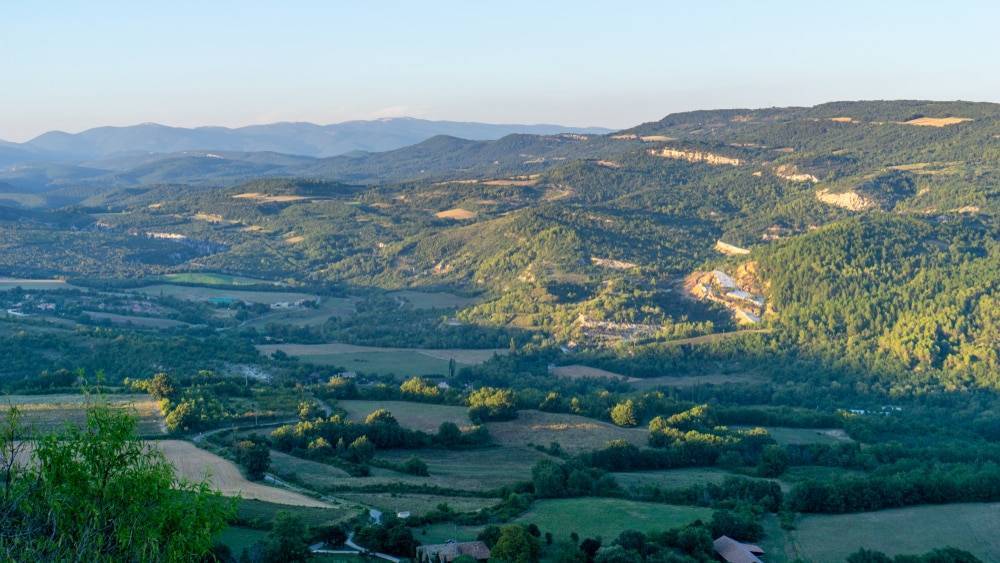
Unspoilt hilltop villages, hills free of housing estates, fields and forests as far as the eye can see: it is no accident that the Luberon has kept this face. For almost fifty years, the area has been protected by a regional nature park that maintains the balance between the lives of residents, economic activity and the preservation of the landscape. For a buyer, this is both an opportunity and a reality worth understanding.
The Luberon Regional Nature Park, a protected area since 1977
The Luberon Regional Nature Park (Parc naturel régional du Luberon) was created in 1977. It covers dozens of municipalities in the Vaucluse and the Alpes-de-Haute-Provence, from Cavaillon to Manosque, from the Petit Luberon to the Monts de Vaucluse.
A French regional nature park is not a reserve where everything is forbidden. It is an inhabited area where people live, work and build, but according to a shared project: the park charter. Signed by the municipalities, it sets out the main guidelines for protecting the landscape, nature and heritage, while allowing the area to develop.
An internationally recognised area
The Luberon is not only recognised in France. It is one of the few places in the world to hold several international distinctions.
- UNESCO Biosphere Reserve: since 1997, the Luberon has been part of the World Network of Biosphere Reserves, today under the name Luberon-Lure Biosphere Reserve. This label recognises areas that combine nature conservation with human activity.
- UNESCO Global Geopark: the Luberon was among the very first European geoparks, in 2000, thanks to its exceptional geological heritage: fossils, ochres, cliffs and landscapes shaped over millions of years.
These labels do not create additional planning rules for owners. But they recognise the exceptional value of the area, strengthen its reputation worldwide and add to its appeal, particularly among international buyers.
"Living in the Luberon means living in a landscape the whole world has chosen to protect."
The advantages of living in a nature park
- Unspoilt landscapes: no large retail parks in the middle of the hills and no uncontrolled building. The setting you buy into today is very likely to be the same tomorrow.
- Solid property values: as new building is limited, existing houses remain rare and sought after.
- An exceptional quality of life: nature, peace, heritage, authentic villages, local produce and cultural life in every season, as we describe in a year in the Luberon.
- Strong tourist appeal: the park's reputation attracts many visitors every year, which may interest those thinking of renting out their property.
- Advice for your projects: the park supports residents and municipalities on landscape, architecture and environmental matters.
The drawbacks and constraints to be aware of
- Limited building possibilities: much of the land is zoned as agricultural or natural, where building is almost impossible. A large plot does not therefore mean you will be able to build on it.
- Stricter rules on appearance: render colours, types of roof tiles, windows and doors, fences: many municipalities impose rules to preserve the character of their villages.
- Sometimes longer timescales: in protected areas, other authorities may need to give their opinion, which lengthens the processing of applications.
- Obligations linked to wildfire risk: in wooded areas, clearing brush around houses is a legal requirement that calls for regular maintenance.
- Often higher prices: rarity and beauty come at a price, particularly in the most sought-after villages.
Who decides what? The role of the municipality and the park
This point is often misunderstood: it is not the park that grants planning permission. It is the municipalities, and therefore the mayor, who grant building permits (permis de construire) and prior declarations (déclarations préalables), based on their planning document, usually the local development plan (plan local d'urbanisme, PLU).
The park's role is different. The municipalities' planning documents must be compatible with its charter, and the park may give its opinion on certain projects or advise residents. Its rules therefore apply mainly through each municipality's PLU. As a result, the rules can vary considerably from one municipality to another within the park.
In some areas, further rules apply. Near a listed historic monument or in a protected site, the opinion of the Architecte des Bâtiments de France (the state heritage architect) is required, and they may impose specific materials, colours or shapes. This is the case in many of the Luberon's hilltop villages.
The permissions to know for your works
These are the general rules in France, which should always be checked with your town hall, as the PLU may be stricter:
- Extension or garden building: a prior declaration is generally enough up to 20 m², or up to 40 m² in an urban zone of a municipality with a PLU. Beyond that, a building permit is required.
- Uncovered swimming pool: a prior declaration for a pool of 10 to 100 m², a building permit above that.
- Façade, roof, windows: changing the external appearance of a house (colour, windows, tiles) generally requires a prior declaration.
- Use of an architect: mandatory when the total floor area of the house after works exceeds 150 m².
- Change of use: converting a barn, sheepfold or farm building into a home requires permission, which is not always possible in agricultural or natural zones.
Before you buy: the right reflexes
If you have a specific project in mind (extending, adding a pool, renovating an outbuilding), it is best to check that it is possible before you sign.
- Consult the municipality's PLU, at the town hall or online on the Géoportail de l'urbanisme (the official French planning portal), to find out the plot's zoning and what is allowed there.
- Request a planning certificate (certificat d'urbanisme) from the town hall. The information certificate sets out the rules that apply to the land; the operational certificate states whether your project is feasible.
- Check that past works were authorised: a pool, an extension or an outbuilding must have been declared and approved.
- Include a suspensive condition in the preliminary sale agreement (compromis de vente) if your purchase depends on obtaining a building permit.
- Meet the town hall to present your project: in the Luberon's small municipalities, an early conversation avoids many surprises.
Your notaire and your estate agent will help you with these checks. Planning rules change regularly and must always be confirmed with the municipality concerned.
Frequently asked questions
Can you build in the Luberon Regional Nature Park?
Yes, but according to the rules of each municipality's local development plan (PLU). Building is possible in the zones designated for it, while agricultural and natural zones are strongly protected.
Who grants building permits in a regional nature park?
The municipality, through the mayor, grants building permits and prior declarations. The park may give an opinion or advice, and the Architecte des Bâtiments de France is involved in protected areas.
What are the Luberon's international labels?
The Luberon has been a UNESCO Biosphere Reserve since 1997, under the name Luberon-Lure Biosphere Reserve, and has been part of the geopark network since 2000 thanks to its geological heritage.
Can you build a swimming pool at a house in the Luberon?
Yes, in most cases. An uncovered pool of 10 to 100 m² requires a prior declaration, and a building permit above that. The municipality's PLU may set additional rules, particularly in protected areas.
Buying in the Luberon with Les Clés du Luberon
Les Clés du Luberon assist with the sale and search for character homes throughout the Luberon Regional Nature Park. We know the villages, their rules and their particularities, and we help you check that the house of your dreams also fits your plans. Our agencies in Lagnes and Fontaine-de-Vaucluse will be pleased to welcome you.