
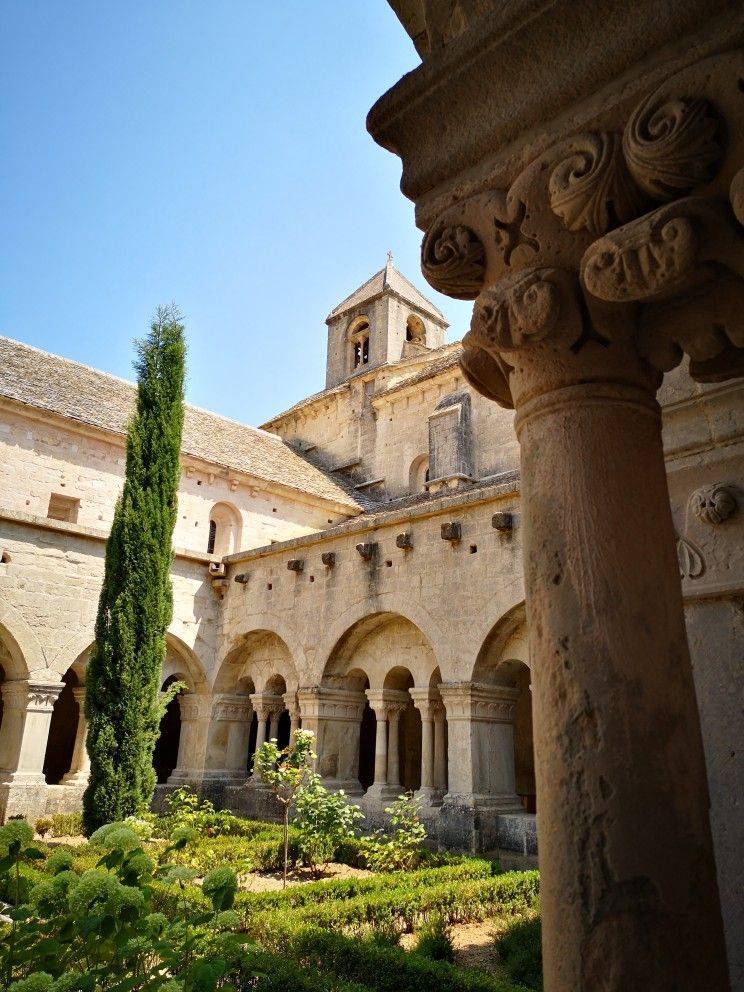
The road leaves Gordes, winds between holm oaks and garrigue, then drops into a narrow valley. Round a bend, it appears below: an abbey of pale stone with stone-slab roofs, set among rows of lavender. The silence is complete. You understand at once why monks chose this place, and why they still live here today.
A Cistercian abbey founded in 1148
Sénanque Abbey was founded in 1148 by Cistercian monks from the Abbey of Mazan, in what is now the Ardèche. Faithful to the Rule of Saint Benedict and the ideals of Cîteaux, they were looking for an isolated place suited to prayer and work. The valley of the Sénancole, the small river that gave the abbey its name, offered exactly that.
Together with the abbeys of Le Thoronet and Silvacane, Sénanque forms what are known as the "three Provençal sisters", three great Cistercian abbeys of Provence built in the 12th century. Over the centuries, it went through periods of prosperity, destruction during the Wars of Religion, and sale as national property during the French Revolution, before monastic life returned.
Architecture of great simplicity
Sénanque's architecture is a model of Cistercian Romanesque art: simple volumes, perfectly cut stone, almost no decoration. For Cistercian monks, beauty was meant to come from light, proportion and the quality of the stone, not from ornament.
One feature often surprises visitors: the abbey church does not face east, like most churches, but north. As the valley was too narrow, the builders adapted the abbey to the terrain. The roofs are covered with lauzes, the stone slabs also found on bories and old buildings in the region.
An abbey that is still inhabited
Sénanque is not a museum. A community of Cistercian monks still lives here, following the rhythm of prayer, work and silence. The monks grow lavender, produce honey and welcome visitors and those who wish to go on retreat.
This presence gives the place a special atmosphere. During visits, visitors are asked to dress appropriately and to respect the silence in the monastic areas. This is also what makes the experience so powerful: you are not just visiting a monument, you are entering a place of life.
"At Sénanque, stone, lavender and silence have told the same story for nine centuries."
Lavender season at Sénanque
The abbey's most famous image is that of its lavender fields in bloom. Flowering usually takes place from mid-June to mid-July, depending on the weather that year. This is when the valley turns purple and the abbey draws visitors from all over the world.
- Come early in the morning or late in the day, for the light and to avoid the crowds.
- Stay on the paths: the fields are cultivated by the monks, and visitors are asked not to walk between the rows.
- Enjoy the view from the road that descends from Gordes, from where you can see the abbey and its lavender below.
Visiting the abbey in every season
Outside the summer, Sénanque regains all its calm. In spring and autumn, the valley can be visited in peace, and the soft light brings out the stone of the abbey. In winter, the atmosphere becomes even more contemplative. Visits include the church, the cloister, the chapter house and the monks' dormitory.
Opening times and visiting conditions vary with the seasons and the life of the community. Before you go, check the official website of Sénanque Abbey.
Around Sénanque: Gordes and the neighbouring villages
The abbey is a few kilometres from Gordes, one of the most famous hilltop villages in France. Around it, other villages are well worth a visit: Murs, on the road to the Monts de Vaucluse, Joucas, a peaceful little stone village, or Roussillon and its ochre cliffs. The Village des Bories, also in the municipality of Gordes, completes the discovery perfectly.
You can also walk to the abbey from Gordes along a footpath that crosses the garrigue and offers fine views over the valley.
Living near Sénanque Abbey
Living near Sénanque means living in one of the most beautiful landscapes in Provence, between Gordes and the Monts de Vaucluse. Houses here are rare: dry-stone mas, village houses, bastides surrounded by land, often with open views over the valley and the Luberon.
This area is also highly protected. As in many Luberon villages, the presence of historic monuments and protected sites means strict rules for building or renovating, often with the opinion of the Architecte des Bâtiments de France (the state heritage architect). Before any project, find out about these rules, which we explain in detail in our article on buying in the Luberon Regional Nature Park.
Frequently asked questions
Where is Sénanque Abbey?
Sénanque Abbey is in the municipality of Gordes, in the Vaucluse, at the bottom of the Sénancole valley, a few kilometres north of the village.
When can you see the lavender in bloom at Sénanque?
The lavender usually flowers from mid-June to mid-July. The exact dates depend on the weather that year.
Is Sénanque Abbey still inhabited?
Yes. A community of Cistercian monks still lives there, following the rhythm of prayer and work. Among other things, they grow lavender and produce honey.
Can you visit Sénanque Abbey?
Yes, the abbey can be visited, with conditions that vary according to the season. Appropriate dress and respect for silence are requested. Check the abbey's official website before your visit.
Les Clés du Luberon, from Gordes to Sénanque
Les Clés du Luberon assist with the sale and search for character homes in Gordes, the Monts de Vaucluse and throughout the Luberon. Dreaming of a stone house facing the hills, a few minutes from Sénanque Abbey? Our agencies in Lagnes and Fontaine-de-Vaucluse will be pleased to welcome you.